Wednesday, April 8, 2015

Stuck in Panama City

March 12th to March 31st

We arrived in Panama City just in time to meet our friends Ben and Kerry, who'd flown down from Boston the night before. Our intent had been to go through the canal with them as line-handlers, but JUMBLE and crew were in no condition for a transit. Our engine, which would have to run for 8-12 hours through the canal, most of them at full throttle, had developed a leaky raw water pump. Several smaller projects had piled up and the rig was loosening.

I spent two days running around Panama City, hemorrhaging taxi fare, looking for parts that simply couldn't be found. Johnson Pumps aren't used here, but there are plenty of Jabscos! To make matters more complex, our existing pump had been discontinued by the manufacturer (despite the engine being only 3 years old), so a new one simply couldn't be found. An optimistic outboard mechanic assured me he could fix the pump and promptly made a mess of things. Chalk up another story about why you should never let a mechanic work on your boat. Finally, the very helpful folks at Dimar, an industrial supply-type place, pieced together mismatching water seals from different size pumps to effect a temporary fix. Ben and I then rebuilt the pump with the parts in hand, while drinking my first decent beer since San Diego: an IPA of some sort. There are a fair amount of imported beers available here in Panama, but at a premium. $2.50+ a bottle at the grocery store.

One of the bearings was starting to rust, no bueno

Pump gutted and read to clean, parts to left

Ghetto arbor press

With the pump 'fixed', it was time to show our guests a little fun. We set sail for Las Perlas, specifically Isla Chapera, about 30 nm from our anchorage in Panama City. It was still in the morning and we motored, but finished with a great spinnaker run down to the island and then a short beat to the north end, with a view of Isla Contadora, which has a small town. We anchored off a pristine, white sand beach and swam in at sunset. Anna rowed in the dinghy and had the last laugh. The Humboldt Current was running strong and the water was full of plankton, krill, small jellies and just general fuck all. On top of all that, the water was cold. We never got the thermometer out, but my guess is around 70 degrees. Quite a contrast to the balmy, empty waters in Costa Rica.

We lucked out with our neighbors that night. There were two other boats and ten people down to party with a big, driftwood bonfire on the beach. Wine and rum were in full effect and even a little bourbon showed up. There was plenty of of bullshitting as we watched a new suite of stars transit the sky. The second night was much quieter and we mostly kept to ourselves, messing around with our weatherfax receiver. Our trip back to Panama City was flat clam and all motor.

Ben's the picture guy, so he chronicled that leg of the trip. His pictures will definitely outshine our usual fare. Look for an update to this post once we manage to exchange them.

After Ben and Kerry went home, we were stuck in a rolly anchorage in need of rest and repair. The rest never came, but the repairs eventually did. Crew service boats run day and night for the ships anchored out. Some of the operators were considerate, but most seemed to enjoy blasting through the small boat anchorage at full speed at all hours. Every boat rolls in these conditions, but JUMBLE is very sensitive to wakes. We're plenty stable at sea and JUMBLE's roll from swell and surge is nothing special, but wake gets us rolling from gunnel to gunnel. It's really something, once the rolling starts you've got to grab your tools and hold on. We broke our french press the second day. I think it has something to do with our roll period, which is shorter than most boats and matches the frequency of many wakes. This might be the subject of a whole other post.

We met several people at the anchorage and everyone knew JUMBLE before we described it, “Oh! You guys are the boat that rolls all the time!” They thought we were pretty salty. We're not and it sucked.

Old Carrier towed to the canal?

Panama City was the least friendly place we visited. I'm not sure this is true of all of Panama, but that was our experience. Likely it's the dickish behavior of city folk everywhere. Traveling by boat, you're usually insulated from fast-paced moneygrubbers, so it was off putting. Small boat cruising is not a priority for Panama City, so facilities are limited and geared towards superyachts and sportfishers: deep pocket dummies. Broke, penny-pinching sailors are treated as a kind of minor nuisance. The anchorages are out on Amador causeway, far from the city proper, because of the extreme, nearly 18' tidal ranges. Getting to town requires riding a taxi, at least until you figure out the metrobus and the new subway system, which is pretty cool. Even still, if you need to go to a seedy area, have a ton of groceries or you're coming back late, you're going to have to use the taxis. After our first few days, we wised up to the price gouging.

Theoretically, the rates are:

$2 within a 'zone' (neighborhood)
$4 across zones
$6 across town

Additional passengers are usually a few dollars more, but I don't know official amount

We almost never got these rates, paying 'gringo prices'. Once you know the scam, it's still a battle to get a reasonable rate. Usually we were quoted $15 for two to get back to the anchorage from the gigantic Albrook Shopping mall. We'd usually offer $2-$4, depending on how many taxi drivers were loafing around. Most drivers refuse outright, a few will argue $10, eventually we'd usually go for $6, a few times for $4. It was a real pain in the ass just finding a taxi willing to give a reasonable rate and it was always an argument, which is simply the way things are.

Lazy shots from the cross-town bus

Sorry about the reflection

Serious construction everywhere

Condo towers surrounding shacks on inundated land

We were also gouged by the various visa and cruising permit costs, which were far higher here than any other place we've visited. A few hundred dollars. Enforcement has been zero, so we now regret paying the fees at all. We counted ourselves lucky to check in on the Pacific side, as the folks we met coming from the Atlantic always paid more. The price of these permits should be the same, but who minds a little graft? There's a fellow in the immigration office who charges $40 for “boat inspections”, or for bags of trash or both. He never saw JUMBLE, but took the money.

Fruit and Veg Market

Add you own caption

Serious dude and girly poster

Paz y sandías

This one cracks me up

Our raw water pump came from the engine manufacturer, $250, with another $250 for shipping. It overnight-ed from California to Panama City in 24 hours, then sat at the airport with a customs 'clearance delay' for a week. I called the local FEDEX branch and got a different story each time. Supposedly a $4 import tax had to be paid and someone would contact me. They told a slightly different story every time. Frustration mounted and finally some experienced sailors explained the process to me over pizza and beers. I used “Yacht in Transit” in the address line and this is apparently code for customs officials to fuck around and squeeze extra cash out of you. Arturo, a local, imports boat parts from Florida and we gave him the tracking number to see what he could do. At the same time, we rode the express bus out to Tocumen Airport, on the other side of the city, to begin our battles with FEDEX and customs. We were advised to act like confused tourists, Anna was there to shed some tears and just generally pitch a fit. We never had to. As we were walking into the cargo terminal, I got a call telling me the pump was at the dingy dock. Somehow, Arturo pulled the right string and accomplished in a day what we'd been trying to do for a week.

The Panama Canal Authority was the easiest agency to deal with. There was a little hitch with our admeasurer, who gave us a little BS about our minimum required speed: 8 vs 5 knots. This is a big issue for sailors, but this post has become too boring, so we'll move on. Roughly $1100, plus a $900 deposit, to transit the canal. This price includes some enormous lines (ropes) we rented and used tires (as additional fenders), that I bought for a $1.


We gave the engine a full lube and service, gathered crew and supplies and set out for the canal on March 31st. I guarantee that the Canal Post will be much more exciting, but I wanted to offer a little perspective on the painful minutiae we often get slammed with while traveling on JUMBLE.

Serious skyline for a city of 900,000

Friday, March 20, 2015

The Bash to Panama City

This post begins the slide of Jumble Ventures into disorganization and sentimentality. Any readers without the stomach for such nonsense had better steer clear.

JUMBLE and her crew made it into the La Playita anchorage of Panama City on March 12th, having left Puerto Chiapas, Mexico on February 18th with the intent of making a non-stop passage of approximately two weeks. Like all cruising plans, these were written on the beach at low tide and things didn't work out as planned.

Village in Bahia de Jiquilisco
Crossing the bar behind PELAGIC


After our little bash off Guatemala, we had a clear weather window for Nicaragua and the Gulf of Papagayo and didn't see anything more than Force 5. The Papagayo winds are funny: they're initially on the nose, as you parallel the coast, then they're on the beam and finally you get a short run at the end.

Anna and entourage
Hot weather rig: give up some speed for shade

In Costa Rica we experienced the calmest seas we've ever seen on what was, technically speaking, the ocean. Groundswell barely noticeable, winds less than 5 knots and water temperatures in the low 80s. We stopped one night in Drake's Bay and had some gallo pinto and threw our last $USD at some diesel. No sailing to be had in Costa Rica; not without the patience of a saint.

Truly, the Pacific Ocean

Super Swank Resort in Drake's Bay

JUMBLE alone, except local pangas

Tree, of some sort

Rain?


Panama became a shitshow past Islas Ladrones. We had force 6-7 for a few hours in the morning, then less than 5 knots in the late morning/afternoon, only to get smacked with force 5-6 in the evening around Isla de Coiba. JUMBLE had some charging runs and got to try a few sail combinations for stronger winds. We had a brief pause in the wee hours of the morning rounding Punta Mariato. Lucky for you, there are no pictures of that night watch. Conditions and wind directions were variable and we were too close to land to put trust in either self-steering system, so I hand steered the 1 to 4 am watch naked in order to keep my clothes dry and salt free. 80+ degree water and air temps make clothes a formality. The spinnaker made a nice bean bag chair in the cockpit footwell, so I kept out of the spray and wind.

Upwind/Downwind off Ladrones
Coiba, boring pic

The 15 or so mile approach to Morro de Puercos kicked the shit out of JUMBLE. I really felt for our plucky little boat. We spent several hours just holding position with motor and bare poles in what I can guess was a gusty force 8 or more. I know this sounds absurd and I had a hard time believing it myself. Still, the double reefed main looked ready to pull away from the mast. The top sail slide eventually ripped its webbing later in the day after we'd resumed sailing. Just for shits, we tried lying a'hull, just to see how it felt. There was no threat of capsize given the small wave heights. With the sort of winds we were experiencing, lying a'hull was actually pretty comfortable, but our drift of 1.5 knots would have quickly taken us away from the shelter of a weather shore and our destination. The trade/offshore winds were really howling and we only made Benao cove late that night as the winds moderated to force 5-6 past Morro de Puercos.

Early morning break

Upwind/Downwind Morro de Puercos

Benao at low tide, long dinghy drag


After a couple days of rest/repair we set out for Punta Mala ('mala' means 'bad' in Spanish) with a small craft advisory in the forecast, force 6-7. For those of you without knowledge of sailing and the 'point effect', know that a cape or point generally increases the local wind strength and JUMBLE is most definitely classified as a 'small craft'. Not the correct decision, but we were on a schedule and hadn't been beaten. Not yet anyway.

Well, I'd like to think it wasn't the wind strength that beat us, but the current. There's a wicked 1.5-2 knot current setting south right off Punta Mala. In other words: directly against us. A colorful local in Benao told us the current ran 5-6 knots sometimes, but this is sailor's exaggeration. We charged Punta Mala under double reefed main (the new standard set) and 85% jib, luffing in the gusts, making 6-7 knots to the east in a NNE force 7. Once we cleared the potato patch off the point, the wind moderated to force 5-6 and we set the mizzen. The waves cleaned up a bit as well. We then spent 10 or so hours tacking back and forth with that goddamned current and managed to make only 2 miles to windward! For various reasons, mostly provisions and single-minded determination, we were unwillingly to shoot over to Las Perlas islands, which was a course we couldn't lay direct anyway. Finally, we threw in the towel that evening and ran back to Benao with our tail between our legs.

Rage and self-loathing accompanied this decision. Other than the usual salt sores, sodden bedding and lost hawsepipe cap, no real damage had been done except to our (mostly my) pride. This was the first time we ever turned back. Sure, we had made unscheduled stops, but that's not the same thing. Not only did this mean we couldn't hack the conditions, but that the choice to put to sea had been in error. This also marked the first time that it wasn't so much the crew as it was JUMBLE that wasn't up to the conditions. JUMBLE is a tubby little ketch, not suited to making miles dead to weather in an adverse current and moderate seas. Previously, it had always been the crew, our weak morale and stomachs, that let us down. This time it was just the futility of trying to force JUMBLE against the prevailing conditions.

Morale was high on the first attempt

Upwind south of Punta Mala

Lesson learned: get a bigger, faster, more expensive boat. Subscribe to more yachting magazines.

Just kidding.

So we waited a few more days for better weather and had an epic struggle to wrest money from our dinky credit union in middle-of-fucking-nowhere Panama on a Sunday. We made a few repairs and had a drunken evening with some surfers who helped us get fuel and water. With a clear forecast, all was well until I discovered the seawater pump on the engine had a failing water seal. Not exactly a bullet in the head, but worrisome as we were planning on motoring the last 100 miles in calm weather. This is a spare part I think most boats should carry, but in the rush and budget to leave we didn't buy a spare pump. If the failure progresses too far it means salt water in your engine's oil. Serious shit. We cleaned the heat exchanger and checked all inlets and outlets of the raw water system, as 700 hours seems awfully soon for such a pump to fail. We checked the oil every three hours during the end run.

Mellow Mala on the second attempt
Pacific Anchorage, super cool views

More Pacific Anchorage

More Pacific Anchorage

More Pacific Anchorage


Our gamble paid off and we made Panama City the morning after our friends flew in from Boston. We drank our last gift booze: champagne from FREE LUFF. The plan was to save it for getting through the canal, but hell.

La Playita de Amador


More info about our first week in Panama to come.

Monday, February 23, 2015

Puerto Chiapas to Bahia de Jiquilisco

2/18/15 – 2/21/15
260 NM

We left Chiapas around 1400 and had a very ordinary first 24 hours. Minor teething issues from being in a marina for two weeks were quickly rectified. The 19th being my birthday, Anna made a nice dinner and we shared the last two beers around 2000. We don't drink on passages, but made an exception this evening. Little did we know what was in store for us.

JUMBLE was running 25 NM off shore, near the border of Guatemala and El Salvador. The offshore breeze started slightly earlier than usual, filling in nicely at 10 knots from the N by 2030. We planned for a good night of sailing and discussed preparations for the Papagayo winds we were bound to encounter in a few days off Nicaragua and Costa Rica: stowage, securing deck gear and generally being prepared for a blow.

The offshore wind ramped up quickly after dinner. It hit 20 knots and we dropped the main, not expecting the wind to last. Within a few minutes, we realized that this was a mistake as the wind was reaching the high 20s and the waves suddenly got nasty with the bowsprit poking into the water and lots of spray. We had difficulty holding the bow into the waves with just the mizzen and it was a fight to douse the 170% genoa. We set the 105% and tried to continue on course, which was now a close reach, the wind coming from NNE and our course being generally E. The 105% isn't our best sail and the top was twisting off the the gusts. We set a double reefed main to get enough power to head upwind in these conditions. Once we had the main set, the 105% was too much as winds were reaching 30 knots and we considered the blade jib or storm jib, both much better sails. Given our proximity to a weather shore, we decided to douse mizzen and jib and motor sail NNW on a starboard tack towards shore and shelter. Our other option, certainly more comfortable, would have been to run off south or west, taking us away from our destination. The waves were steep, but only had 25 miles of fetch. On a starboard tack, our engine intake was solidly in the water and once near shore the waves would be much smaller. When we finally reached shore around 0300 or 0400, we spotted a cluster of shrimpers, lights burning bright, hugging the shore as well.

So from 1000 until the wee hours of the morning, JUMBLE motored into steep chop and took quite a beating. The autopilot repair held, and we were able to sit safely at the nav station with the lower hatchboard in and the canvas flap down over the companionway to keep out the spray. We took the top of one weird wave through the companionway, sideways. JUMBLE was tossed to 45 degrees a couple times and we had a few items come loose inside, but nothing too serious. We were only able to make 3 knots the first few hours, but once closer to shore the waves had less punch. The wind lost none of its ferocity near shore. We experienced our first gale at sea. Without instruments I can't be sure of the exact speed, but 35 knots at least. In the early morning, as we started to skirt the 60' contour near shore, the rig sang a tune I hadn't heard before, so I'm sure there were gusts above 40 knots. Mountains and volcanoes line the shore here and I suspect the norther was accelerated by these and in the canyons between them. There isn't as much weather recording in this part of the world, so we've only been able to confirm with one other sailboat further ahead of us who caught some action in the 30s and the locals here in El Salvador who told us a Frente Frio (Cold Front) passed through that night. Our forecast, less than 48 hours old, had called for light and variable less than 10!

Daybreak on the 20th

Only 1 or 2 miles off the beach


We took 1-2 hour watches from 1000 to 0800 the next morning, when things calmed down almost as quickly as they had started. The off watch took the bunk. On watch I took the floor or nav station, Anna favored the nav station. I had been slightly seasick before the wind started, maybe two weeks in a marina, but it didn't get much worse once it started blowing. The hilarious thing was remembering our first few Catalina trips, mild as they were, and how much sicker we both were then. Being a little sick at least gave me an incentive to go out into the cockpit and get soaked taking a look around. Not that it mattered as all the fishing traffic had already run for shore. I timed my lookouts to every two “incidents”, which I defined as 'prop leaving the water', 'wave breaking on hull' or 'boat stopped by wave'. All of these were distinct sounds so you could keep your eyes closed. This corresponded to about 15 minutes at first, but all these were gone near shore. Near shore we had to keep a close eye on the chart, GPS and depth sounder until daybreak. One funny thing: when we first got hammered, the depth sounder went crazy beeping and reseting itself continuously. It took us a moment to realize that it was because it was being lifted out of the water by the choppy waves. Probably a common occurrence, but the first time it's happened to us. 

All clear 

Things cleared quickly and it was a lovely, relaxing morning with a big breakfast and calm seas by 0900. Our overriding concern during the night was damaging gear, we never felt unsafe, just uncomfortable. The only casualty was one of our air-vanes for the self-steering, presumably lost over the side. It's something easy to fabricate, plus we have two others. If we'd stowed our deck gear properly, we wouldn't have lost it. Lesson learned.


Our plan was to make it all the way to Panama from Chiapas, but we didn't pack as much fuel as we should have and used more than expected the evening of the 19th. With the Papagayos blowing along Nicaragua (according to our bullshit forecast) and east swell to confirm it, we decided to moor at Barillas Marina in El Salvador on the morning of the 21st. It's called a marina, but it's more of a resort with a mooring field deep inside a lagoon. You need a pilot to navigate the bar at the entrance. We have a guidebook, a few years old now, that has waypoints, but the bar has definitely moved since then, so we waited for a panga to come out and guide us in.


This post has already gone on too long and we need to depart early tomorrow morning for the tide, so I'll wrap things up, but this is a pretty nice place and very reasonably priced. One of those stops you're glad you stumbled upon and wish you could stay a little bit longer. We did get to rest up, do a little walking and enjoy some nice scenery. Maybe we'll come back for the volcanoes.

Crossing the bar

Lempa Shoals

Inside the Bahia de Jiquilisco

Dock and Moorings

Semi-Domestic Spider Monkeys on the Plantation

Tree o' Monkeys

The caged fellow quarrels with the Alpha

"How Cute!"

Alpha Female "Maria"
Little Gator

Croc' didn't show up in shot

View from a hammock

Horse Ranch, Polo field to right

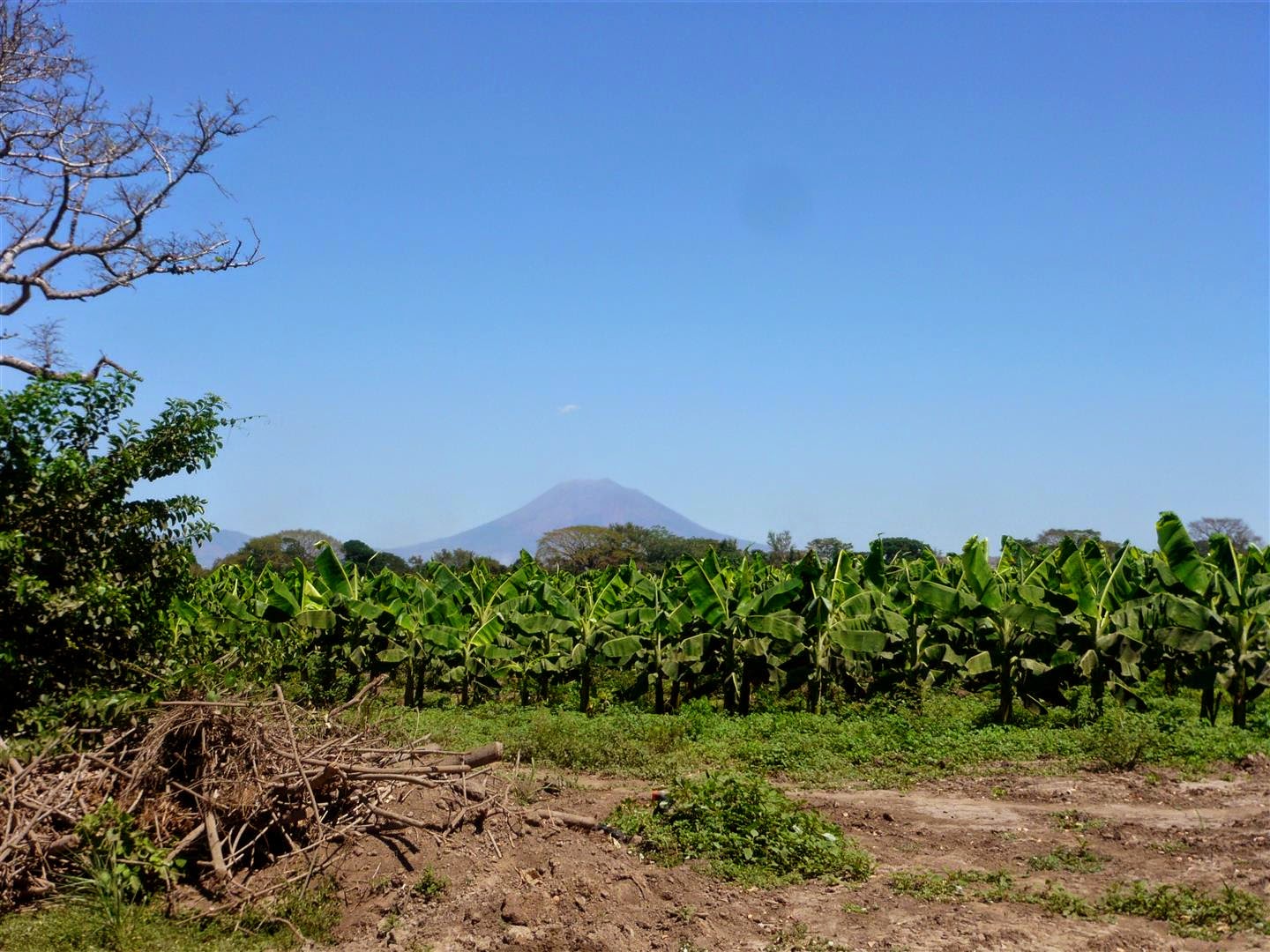
Bananas
So we're bound for Panama on the 24th. If we make another unscheduled stop, hopefully it'll be as pleasant as this one.