April 2nd to 17th? First part of April
After offloading our volunteer crew, JUMBLE spent several days at
Shelter Bay Marina. Other crews had warned us about Shelter Bay. It's
quite nice: there's a boatyard and even a workspace with some
decrepit shop tools for owners to do their own work. The trouble is,
any attempt to get work done in Shelter Bay is undermined by the
marina's isolation from Colón and the sultry weather. The folks in
charge have this all figured out and provide decent showers, a pool
and air conditioning in the cocktail area.
For most of the day, sailors with A/C hide in their boats, while
the rest of us loaf around under whatever shade we can find. Cocktail
hour is most of the day. In the evening, it's impossible to walk down
the dock without meeting some new people. Before you know it, you're
sat in an unfamiliar cockpit drinking rum, lousy beer or boxed wine
for most of the night.
"Tomorrow", you tell yourself, wondering where the day
went, "Tomorrow, I'll get to those projects"
 |
| Marina |
 |
| Yard |
 |
| Hazardous Cargo Anchorage |
Crews from all over the world converge in Shelter Bay, preparing
for or completing a Canal transit. Most were headed to the South
Pacific. Of course, JUMBLE was going the wrong way. The
Trade Winds were howling when we arrived, so we needed to kill some
time before heading out into the big, bad Mar Caribe.
We spent the first week blitzed most of the day. You really have
no choice in the matter. The marina is situated away from the city
proper, which is probably a good thing because Colón is a dangerous
place, with 40%+ unemployment and rampant street crime: not the kind
of place to walk around with a fanny pack and camera.
Anyway, the
marina basin and its buildings are all remnants of Fort Sherman,
an extensive US military base operated from the 1912 until 1999. Anna
and I really enjoyed tramping around the jungle and abandoned
buildings. The Panamanian government is maintaining the grounds and security in a few areas. On the road to Colón, some of the unprotected buildings have been looted and damaged beyond repair. Deeper inside the base, the weeds are clipped and there's ersatz patrols from the military. One poor guy seems to sit alone all night burning coconut husks, presumably to keep the bugs away. Otherwise, a few other soldiers drive around the crumbling roads in a beat-up Mazda panel-van. I think there might be some potential for nature tourism in the surrounding area, if the buildings are fixed up, similar to what's been done at the marina.
 |
| Chapel |
 |
| Much friendlier than the bats |
 |
| Old Magazine |
 |
| What did you expect? |
 |
| Monkeys everywhere, very vocal at night |
 |
| This area was just foundations, but extensive |
Fort Sherman was originally built to defend the Canal Zone and several large
coastal artillery batteries were erected coincident with canal construction. Coastal artillery became obsolete
during WW2, but the base remained. Fort Sherman found its true
calling as the Jungle Operations Training Center (JOTC) in the 1950s.
The terrain around the base is beautiful, with a
mixture of canopy jungle, marshes, some hills and, of course, coastline. Fort
Sherman was the only US military installation at the time situated on
actual jungle, so it was a valuable asset for training both US and
allied (mostly Latin American) personnel in jungle warfare. From what
I've read, the training provided at the JOTC proved
valuable, especially during the Vietnam War. Agent Orange was apparently tested in a mysterious area called the "drop zone". Descriptions from news articles and veteran's sites weren't clear enough for me to pinpoint this area on the ground or Google Earth.
 |
| Lots of leaf litter |
 |
| Anna for scale |
 |
| Battery Baird |
 |
| The wall extended a ways into the jungle |
 |
| Small Doorways |
 |
| Note termite nests |
 |
| Spalling is everywhere in Central America |
The JOTC and US Army School of the Americas, located at
nearby Fort Gulick, were somewhat controversial. The stated goal of
the School of the Americas was to provide "anti-communist
counterinsurgency training” to US- allied Latin American troops.
Torture techniques were part of the curriculum and famous graduates
are a cuddly mix of dictators, cartel enforcers and junta-types. Relocated to Georgia, the school is now euphemistically named the "Western Hemisphere Institute for Security Cooperation"
 |
| Trees dwarfed the structures |
 |
| Creepy kennel |
 |
| Agouti |
 |
| This area was casually guarded, the gate was usually unlocked |
 |
| Funny names for this part of the world |
JUMBLE left Shelter Bay after about a week to wait out the winds at the Chagres River, a 10-15 nm sail, but only 6 miles from the marina as the crow flies and still part of the former base/American Zone. The jungle is high and thick. We were unable to get any radio communication with folks in the marina, even at that distance.
The Chagres River has a somewhat narrow entrance over a bar. I'm still cagey about those kind of entrances, especially in moderate conditions, but it went OK. Commanding the hilltop are the ruins of Fort San Lorenzo and the village of Chagres, depopulated in the early 1900s for the Canal. The fort was established by the Spanish in the late 1500s, but was attacked several times and rebuilt. The Chagres River provides water for the entire Canal and is dammed 7 miles upriver. The entire area, once part of Fort Sherman, is now part of the San Lorenzo Protected Area. The river is quite deep past the entrance: 35 to 45 feet. The current is sluggish and the water brackish at the surface, salty otherwise.
 |
| Chagres Approach, note breaks on Lajas Reef |
 |
| Safe water under the fort |
 |
| River Entrance |
 |
| Fuerte San Lorenzo |
 |
| "Hey Ya'll" |
 |
| Cloud shows every night |
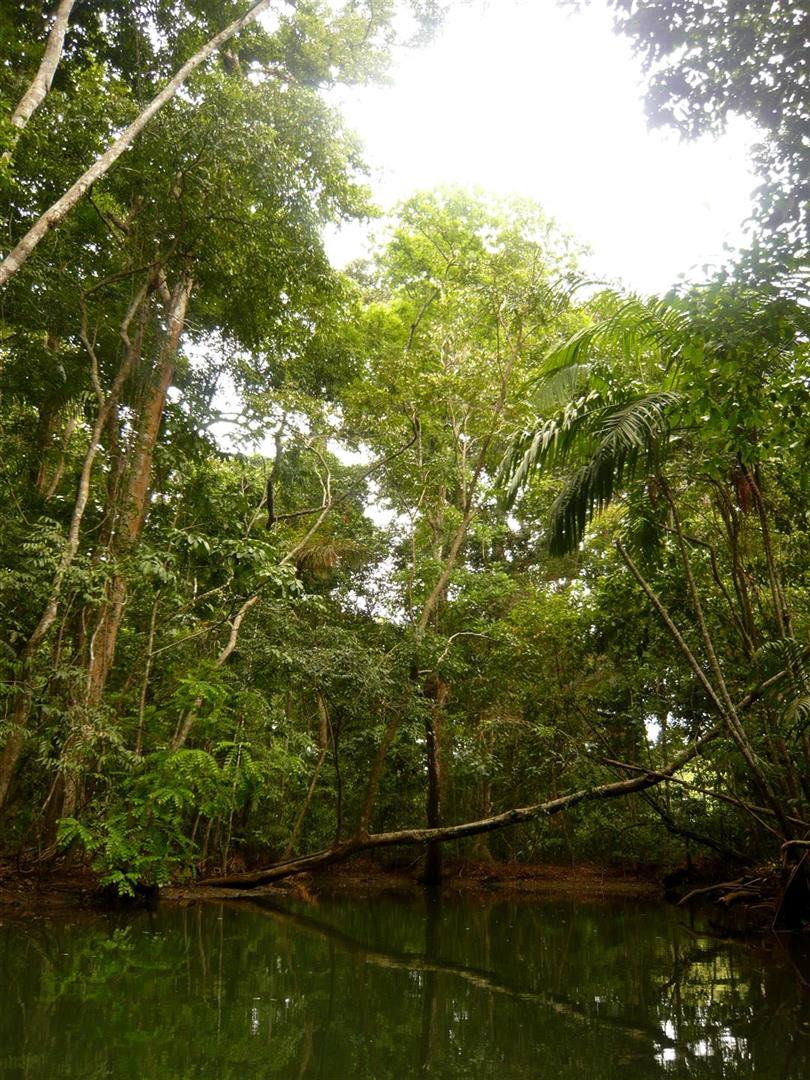
We had a great time at the river, staying for almost a week. It rained every night, but the bugs weren't bad. Ants, termites and a few giant wasps would fly aboard occasionally, but few mosquitoes and no sand flies. I chalked this up to liberal pesticide use by the US military, but apparently most jungles aren't that terrible for mosquitoes and sand flies. Beaches, marshes and mangroves are another story. Howler monkeys and all sorts of birds kept up a background soundtrack. Crocodiles prowled the shores at night. You could spot their eyes glowing red with a flashlight. None seemed very large and we didn't see any during the day. We were apprehensive about swimming for the first day or two, but got over it. Overall, we did a ton of reading and a little exploring.
 |
| Rowing the shallow side creeks |
 |
| Ambitious palm |
 |
| Gatun Dam Spillway |
When JUMBLE finally left, our forecast was a week old and we were in for a treat.